
Talk about how we talk about American history seems to be everywhere this 250th anniversary year of the United States of America. Two new nonfiction books for kids bring unique and contrasting methods to exploring this doubleheader of a topic: when did what happen and how can we understand events honestly now that time has passed? Both books succeed in their aim to be accessible by kids in elementary school and both can hold the interest of older kids and adults, too.

Two Books with Some Common Features
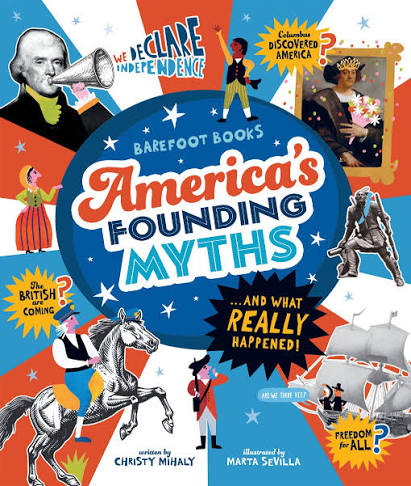
Both AMERICA’S FOUNDING MYTHS…AND WHAT REALLY HAPPENED, by Christy Mihaly, illustrated by Marta Sevilla, and published by Barefoot Books, and AMERICA AS IT HAPPENED, by What On Earth! and The Washington Post, and published by What On Earth! bring readers deeply researched secondary source information. That means that they do not deliver primary sources but well-grounded and accessibly delivered information drawn from primary sources. The intention of both books is to give readers a deeper and more nuanced understanding of both American history and how history’s recording is mutable and always arrives with a point of view that is intentional. Both show the inherent subjectivity of reporting history in ways that give readers experience with recognizing that history itself, and thus American history, differs from provable scientific facts. History may be delivered to us through written or spoken words as texts or speeches, or through images created by artists or photographers, and even through voice recordings and recipes. There is always, however, an element of subjectivity because it is itself a human story, rather than a replicable demonstration of natural forces. Both books take note of this subjectivity, albeit addressing it in different ways, and both use engaging graphics and immersively displayed details to communicate their information effectively.
Two Books with Different Methods of Revealing History
AMERICA’S FOUNDING MYTHS takes each of its 15 events singly, describing the popular (mis)representation of it and a sourced description of what actually occurred. AMERICA AS IT HAPPENED presents its many instances of events each as a newspaper-style account created specifically for this title.
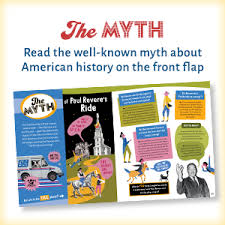
AMERICA’S FOUNDING MYTHS…AND WHAT REALLY HAPPENED concerns 15 specific historic events from the 15th to 18th century. Each event has been a national cultural lodestar, featured in popular accounts including songs, poetry, and as narrative device for teaching and learning about the relevance of the event to our history. However, popular accounts such as these have lots of holes, inaccuracies, and outright fabrications. What REALLY happened? We have both myth and factual accounts served, clearly labelled to indicate which is which. There are flaps, cartoons, and other prompts for considering how facts may be the basis, but not the backbone, of the myths.
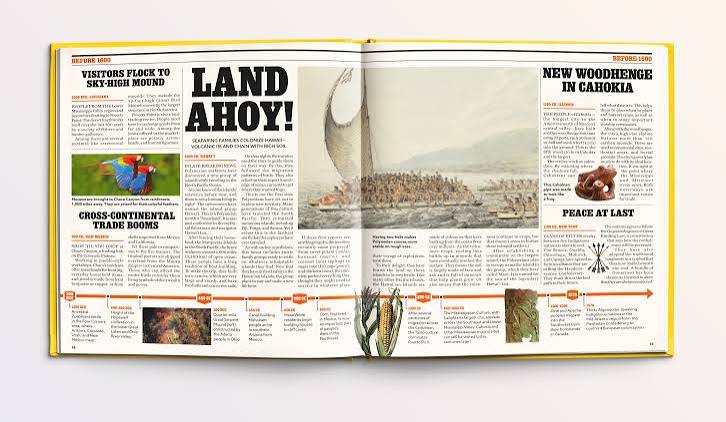
In contrast, AMERICA AS IT HAPPENED seeks to address the scope of continental geological and anthropological history right through the first year of the 47th Presidential term. All these distinct moments in social, cultural, and political time make for a tome that can be browsed or used as a sequential study aid. Such an enormous scope means that instances must have been selected, but unlike the selections described in the other book, our attention is not drawn to the fact that many instances must have been omitted. Each event is detailed in “news” accounts that have been created for this volume to provide contemporary readers with a felt sense of what the news might have been back when it was news.
The Subtle Messaging of Book Design
Both titles utilize design elements to communicate aspects of their content and the intended educational outcome of reading it. Fold out pages in AMERICA’S FOUNDING MYTHS first show the myth as communicated through popular culture and then, when unfolded, the “hidden” facts behind the myth. AMERICA AS IT HAPPENED seeks to place readers in a perspective created by composed journalistic accounts that flesh the history timeline that unwinds through the pages. It is important to note that these “news articles” are not archival but instead written in the 21st century in a manner intended to reflect the times, places, events, and people of each moment of history in a “you are there” manner.
Both books make strong use of blurbs, asides, supplemental illustrations, and other graphic details to more fully detail each piece of history an individual entry presents. Both provide back matter and other transparencies around sources and how the authors informed themselves when preparing to present their accounts.
Beyond American History, Learning How History “Works”
Both these books are geared to the capacities of older elementary school readers, who are beginning to be able to use abstract thinking, while holding considerable interest for middle school and high school students, as well as for adults. At each level, presentation style—especially when both books are read with awareness of the other—can amplify reader understanding of how history itself is both recorded and later recounted in a different time period. This is a powerful lesson in critical thinking: what do we know? How do we know it? How do we judge the veracity of the account before we even arrive at questioning the motives, achievements, and shortfalls of our ancestors?
Barefoot Books’ has provided a Discussion Guide that can help focus critical thinking group discussions or even individual learning.
Critical Questions When Looking at Historical Information
History is an excellent way to practice critical thinking and evaluation skills. Keep these questions in mind as you consider the accuracy of information presented as factual:
- Who said it?
- With what authority did they speak on this (such as specialized scholarship, eyewitness, etc.)?
- Why did they say it (such as to convince, to provide an easy memory tool, to sell newspapers, etc.)?
- When did they say it (and how does that influence their perspective–and ours)?
- Who was their intended audience (such as students, casual readers seeking entertainment, etc.)?